
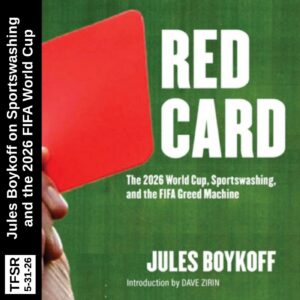
This week, as the 2026 FIFA World Cup looms across Turtle Island, we’re pre-sharing an interview with Jules Boykoff about one of his latest books about international sports spectacles, the upward money flow and authoritarian political power they facilitate but also a bit about the folks that are fighting back entitled Red Card: The 2026 World Cup, Sportswashing, and the FIFA Greed Machine (O/R Books, 2026).
- Transcript
- PDF (Unimposed) – pending
- Zine (Imposed PDF) – pending
- Jules’ recent memoir, Kicking
- Essay on FIFA Greenwashing
- Recent guest James Stout’s book on the 1936 Peoples Olympics
- CONIFA alt to FIFA:
- Anti-Fascist Football Coalition
- Peoples Football Coalition
- NOlympics LA
This conversation falls into the same series as the recent interview with Kristian Williams and Sam Schmidt as regards evacuation of public spaces and attacks on community by the state and capital in the aid of police state capitalism.
. … . ..
Featured Track:
- TFSR by The Willows Whisper
. … . ..
Transcription
TFSR: We’re joined by Jules Boykoff, professor of political science at Pacific University in Oregon, and author of a number of books—most recently Red Card: The 2026 World Cup, Sports Washing, and the FIFA Greed Machine, just out from OR Books. Jules also is a former professional footballer and just published a memoir of those times entitled Kicking, out from Duke University Press. Thank you so much for joining us. Do you want to introduce yourself further with your pronouns or other information that would introduce you to the audience?
Jules Boykoff: Thanks so much, Bursts, for having me on today. My pronouns are he/him, and I am just really pleased to be able to have this conversation with you today. Thank you.
TFSR: Yeah, thank you. So, this year, the US, alongside Mexico and Canada, will be sharing the privilege of hosting the FIFA World Cup tournament under the name United 26. Could you introduce us to the World Cup, who FIFA is, and their current administration under the leadership of Gianni Infantino?
JB: Absolutely. So, this summer’s World Cup in the United States, Canada, and Mexico will be the biggest World Cup in the history of the tournament. The tournament started in 1930 in Uruguay and had only 18 matches, 13 teams, and this time around it’ll have 48 teams, and more than 100 matches. So it’s really grown over time. In fact, it’s even grown since the last time the Men’s World Cup was held, only four years ago, in Qatar, where there were 32 teams. And FIFA, who you mentioned, is the world governing body for soccer. They are supposedly a nonprofit, but wow, they’re a profitable one I gotta say. We’ll get into that, I’m sure. They’re based in Switzerland where they have nonprofit status. They’re led currently by a guy named Gianni Infantino, who you mentioned, who is a heck of an interesting guy. Your listeners may recognize him because he hangs out with Donald Trump all the time. They’re two peas in a pod, really. Honestly, Gianni Infantino has probably spent more time in the Oval Office than most world leaders.
One thing about Gianni Infantino is he knows how to suck up to powerful people in order to keep the FIFA money spigot wide open. He kind of specializes in this. He took over the organization after this huge corruption scandal that hit FIFA back in 2015 and a lot of people thought Infantino was going to make it a little more transparent, a little more just. Wow, were we wrong. Who thought that? He’s basically just used the opportunity to run FIFA in ways that allow him to cozy up to people like Vladimir Putin, the emirs that were running the Qatar World Cup, and now President Donald Trump. So we’re in for a wild ride, I think, with this World Cup. I know it is in three countries, but really the dominant one is the United States. It hosts three quarters of the matches. Honestly the reason why FIFA picked this trio is because the United States represents a huge market and a chance to keep that money spigot that I mentioned wide open.
TFSR: People might remember Gianni Infantino’s name from actually providing accolades and a surprise award to President Trump for his great efforts at bringing peace to the world. I don’t know if you wouldn’t mind taking a second to just talk about that spectacle.
JB: So, in December 2025 Gianni Infantino handed President Donald Trump the FIFA Peace Prize—the inaugural FIFA Peace Prize. It was, you’d think, a gesture of irony, but he did this on his own, Infantino. He apparently didn’t talk to a lot of the members of the powerful FIFA Council. They were blindsided by it, and they read about this in a press release. When Human Rights Watch tried to figure out, “Well, what are the criteria exactly for this FIFA Peace Prize?” They found they couldn’t get any straight answers from Gianni Infantino or FIFA, so it appears to be just Infantino doing Infantino things, creating shiny awards for President Trump. We know he has a predilection for succumbing to the love of gold. Trump accepted the prize, and said it was a great honor. It got to make him look important on the world stage. It was during the draw, so that was the day they were pulling the groups for this FIFA World Cup. Obviously, since then, President Trump has demonstrated—if it wasn’t already clear before that—that he definitely doesn’t deserve any kind of peace prize. He is literally threatening genocide and war crimes on Iran, one of the participating nations in the World Cup. But I think, aside from being kind of a ridiculous joke and irony, it does show the lengths to which Gianni Infantino is willing to suck up to President Donald Trump. If you really want to understand sportswashing this summer, you have to look at Gianni Infantino, because he is sportswasher-enabler #1.
TFSR: Yeah, just to note, like on other relationships between the two, he announced the opening of a FIFA office in Trump Tower New York. Isn’t he on the board for the International Olympic Committee? Which is going to be hosting the games in Los Angeles?
JB: He is.
TFSR: So he’s got these two huge business ventures planned now and then in two years to suck up public money and create opportunities for the Trump regime to be able to siphon off money to his own patronage networks, as well as funneling some of that money back into Trump’s organization directly through renting in his own building, right?
JB: That’s right. And he’s probably at the forefront of bringing Russia back into the fold for both the World Cup and the International Olympic Committee, so that’s another thing to keep an eye on.
TFSR: So, how did the United 26 get the contract to host? You’ve already mentioned that it’s the largest game so far, but can you talk a little more about the scale, and can you talk about the rights and responsibilities for hosting venues, cities, and nation states? What is expected, and what do those localities receive out of hosting these games?
JB: So, the United 26 bid team, as they’re known, the one that represented United States, Canada, and Mexico, put forth a bid back in 2017 during President Trump’s first administration, and there was only one other competitor that put forth a bid at that time, and that was Morocco. You can actually access the bids online. It’s fascinating, really, because when I look at the bid from the United States, Mexico, and Canada, it kind of looks like a document plucked from an era that seems like a long time ago—like this should be in some musty archive somewhere, because things have changed mightily. For starters, these documents are known for making huge promises, and a lot of times people don’t really actually follow through on those promises. Because the people bidding say things like, “Oh, we’re going to give you this tax break” —which they are doing in this instance. Or “we’re going to pay for this, we’re going to pay for that,” or “we’re going to make it the most inviting World Cup ever, and we’re going to have human rights be a big concern, and we’re going to really look out for the environment, we’re going to really care about environmental sustainability.” I mean, all of that was bricked into the bid that the United States, Canada, and Mexico put forth way back in 2017.
Another interesting element in all this when the United States and Canada and Mexico were going up against Morocco, was the sort of sub-rosa whisper conversations that were happening in the hall. Folks were saying, “Hey, look, FIFA and voting members of FIFA, you don’t need to worry about Donald Trump being here, we know he’s kind of obstreperous and says things that don’t chime with our human rights principles and green principles in this bid we’re putting forth. But there’s no way he’s going to be here, because if he wins the next election, then he’ll be out before this next World Cup.” Not anticipating what all your listeners know happened, where he skipped out a term and Biden was in there for four years.
So, when it comes to the rights and responsibilities that you were talking about, the way I look at it is this way: the FIFA business model is essentially that the public—the taxpayers in these various host cities and countries—they pay. So the public pays, and the private entities profit. I’m talking about the corporate sponsors, I’m talking about FIFA itself. Gianni Infantino often talks about how this World Cup alone is going to bring in some $11 billion in revenue for FIFA, making it the most lucrative sporting event in the history of sporting events. It wouldn’t surprise me at all if actually he brought in more than $11 billion for this World Cup.
What the host cities and countries do is they supply things like the policing. They supply things like medical staff to be on hand or things like transportation. If you went to the World Cup in Russia in 2018 or Qatar in 2022, your ticket—if you had a ticket to a match—was your visa. And that also gave you a chance to ride around for free on public transit. At least in Russia, you could go anywhere in Russia if you had a ticket to the World Cup. Obviously, that’s not what’s happening here, but that’s the way that those countries decided to make their promises. So, I would say that the main thing to keep in mind is that FIFA and their allies in the corporate world tend to profit from these things, and they offload as many costs and responsibilities onto local populations as much as possible. We’ve seen now as the tournament approaches, how a number of cities are like, “Whoa, I didn’t see this coming, I didn’t expect this.” They’re also seeing fewer and fewer people making hotel reservations, which means they’re not going to get the economic boon that was promised in that original document we were just talking about. I would say that it’s kind of a bit of a hoodwink traditionally, because you promise everything and then you don’t necessarily have to follow through.
The last thing I’ll say is—hey, if you make a bunch of, let’s say, hyperboles in your bid, and then you don’t follow through, it doesn’t matter. I mean, FIFA just jumps in their private jets and goes off to the next venue, they don’t stick around. If you say, “Oh, you know, you promised you’re going to be more green, and you’re not doing that, so you’re going to get fined for this and that.” No, that doesn’t happen at all. Certainly, FIFA pays no penalties for having big promises in these areas and not actually following through.
TFSR: So, throughout your book, Red Card, you cover the history of the World Cup tournament over the nearly 100 years of its existence, starting with lofty goals of supporting the spread of soccer and bringing nations together in healthy competition through sports in the aftermath of the bloody First World War. This period also saw other international ventures like the state-centered rebirth of the Olympic Games, as well as sort of a competitor in 1936 to the games being hosted in Nazi Germany with the anti-fascist popular Olympics, which was scheduled to be held in revolutionary Spain. Can you talk about the celebration of competitive spirit, what politics are baked into these different models, and what this says about what alternatives we could build in terms of this international scale of sports competition and play?
JB: Yeah, so one of the things I do, as you mentioned in Red Card, is talk through that longer history with a focus on how the World Cup has been used for political gain. So I’d start in 1930 when the tournament began in Uruguay, and jump pretty quickly to 1934 where Benito Mussolini used the tournament to create and amplify his version of the “new fascist man.” He was somebody who was the horse-riding macho shirtless guy many years before Putin pulled it off in the 21st century. He realized pretty quick—although he wasn’t a big soccer fan at first, Mussolini realized that he could use this very famous and popular sport to his political advantage. He would often talk about the athletes on the Italian national soccer team as “the soldiers of sport,”—that was one of his terms, “the soldiers of sport”—and how they represented so much more than what happened on the field. So, I always kind of laugh when people say, “Oh, you know, sports aren’t supposed to be political, you’re not supposed to mix the two.” People have been doing it for a very long time, and especially those with a fascist tendency, they’ve often tried to do that while also at the same time, say “sports and politics shouldn’t mix.” They try to have it both ways. So I have a big section in the book on how Mussolini used the World Cup to his political advantage. I also talk about how in 1978—shimmying forward four decades—the Argentinian junta in charge of Argentina at that time was torturing leftists, killing leftists, throwing them alive and dead out of planes into the water. Terrible things. They were also hosting a World Cup, and had none other than the infamous and horrific human rights ogre, Henry Kissinger, helping them by showing up to the World Cup as a guest of the General Videla (who was heading that junta at the time) and basically turning and pivoting to the world media and saying, “You know what, Argentina is getting a bad rap in the press.”
I’m really glad you mentioned the 1936 Olympics in Nazi Germany, in the sense that that was the first Olympics that hosted soccer, for starters, so it fits in the narrative. But it also really points to something that’s crucial about why these authoritarians choose to do this, because if you look back at New York Times coverage of the 1936 Olympics in Berlin—now known as the Nazi games—New York Times coverage was glowing. They couldn’t stop talking about how great Hitler was. They were talking about him as the new Caesar—one of the greatest, if not the greatest leader in Europe today. That’s basically a quote from one of the articles in the New York Times. So, when people ask about whether it’s worth it—well, Hitler sure thought it was worth it. He was getting incredible press coverage in the paper of record from the United States. I trace that history to set a table for the kind of things that we’re seeing in the 21st century.
Along with that, though, I think embedded in your question is: what alternatives are possible? I happen to be a big fan of soccer. It’s been a big part of my life. I mean, I dedicated a huge chunk of my adult life to playing soccer at a relatively high level and going to soccer matches. I see the power in soccer. And I’m not alone, because in the 1920s and 30s there were these things called the Worker Olympics that happened. They were international worker olympiads, and they were happening in Frankfurt in 1925, Vienna in 1931, Antwerp in 1937. There was a big one scheduled for Barcelona in ’36 but then Franco’s coup kind of put a huge damper on that.
The ethos of these International Worker Olympiads was totally different than the World Cup then—in that era, or now as we know it. These Olympiads brought the idea of solidarity, of cooperation, of bringing in working-class traditions. It was about mass participation, not just elite participation. It was about healthy lifestyles, class opportunity, less about hyper-competition, although they would often have a competitive category at these various Workers’ Olympics. It was all about creating international solidarity among workers. These things were absolutely massive, like you would sometimes get more than 100,000 people. Even competing at some of these events, you’d have thousands of people competing at different levels, from beginner to intermediate and people that were actually feeling competitive about it. This was also at a time when there was these Women’s Olympics, because at the Olympics—what they called at that time the “Bourgeois Olympics”—women were excluded. They were thought to be too weak. The people running the International Olympic Committee were gross sexists, and they excluded women. Women organized their own Women’s Olympics at that time, which were also big in the 1920s and 1930s. These were huge, very well-organized events that were enormous, popular events where you could also engage in political education, where you could also support unions, where you could also build those ties that can help in political battles outside of sport. So these were really vibrant spaces.
Now it’s almost 100 years ago, but I’ve seen spaces pop up even more recently than that. I mean, there’s a group called CONIFA. They’re the Confederation of Independent Football Associations. This is a group that’s around today. They are building a totally alternative world to the one of FIFA. They gather together football associations that operate outside of the ambit of FIFA. They have groups—like, some of their member associations include the Tibetan National Sports Association, the Mapuche (the largest indigenous group in Chile), the Kashmir Football association. You’ve got also Northern Cyprus that’s part of CONIFA. You even have a group from the area where I normally live, in Portland, Oregon. It’s called the Cascadia Association Football Federation, from with footballers, or soccer players, from British Columbia, Oregon, and Washington coming together to be Cascadia. So even today there are alternatives to the hyper-commodified, hyper-corporatized sport of soccer that we’ll see on our TV screens this summer.
TFSR: So one of the terms that comes up in the extended title of your book, is “sportswashing.” Can you talk about this term? What does it offer to a host country as relates to internal, national, and ethnic discipline and suppression of dissent. How does how does sportswashing increase spectacular prestige abroad? And how has sports washing been deployed to set stage for internal crackdowns or military interventions abroad?
JB: Sportswashing is when political leaders use sports to distract and deflect attention from chronic social problems at home or from human rights problems at home. Instead they focus the attention on the leader him or herself to burnish their legitimacy in the global eye, and also to set up opportunities for either them individually—or the country that they represent—to make political or economic gains. You’ve honed in on some of the key elements of sportswashing that actually a lot of people miss. Because when people ask whether sports washing works, if you will, they often mean does it work on an international audience? Like I was talking before about the Nazis in the 1936 Olympics—their effort to deflect attention from what they were doing to Jewish folks, to Roma folks, to LGBTQ folks, and others, it worked internationally. It deflected attention from those horrors that they were inflicting on the local population. But you’re right, it can also have huge effects for what happens on the domestic front.
I would argue, in particular instances of sportswashing, that actually the domestic audience is more important than the international audience. I think actually this upcoming World Cup is an example of that. But let me give another example of how domestic audiences are really important to sports washing. The 2018 men’s World Cup in Russia came on the heels of the 2014 Sochi Olympics that happened also in Russia. And after the Sochi Olympics, Vladimir Putin’s approval ratings were sky high, they were higher than they’d ever been to that time. They were at 86% approval. And what did he do with those high ratings? He pivoted between the Olympics that he was hosting in Sochi, and the Paralympics that he was still to host in Sochi, and he invaded the Crimean Peninsula. So he used that popularity rating to actually engage in war, and I think that’s what you’re getting at, I think at the very end of your question. How does it actually facilitate military interventions? It can, it can make a leader popular that enables bellicosity and invasions and all sorts of international war-making.
The other thing that I think is important to keep in mind is that it can provide a handy-dandy pretext for cracking down on dissent at home. There are all sorts of special laws that are passed before and during sports mega-events like the World Cup and the Olympics. Often then that’s a state of exception that comes with the events…The state of exception creates opportunities for new laws that don’t go away after the actual event. Let me give an example of that: the Paris Olympics of 2024. In advance of that, there was a special law that was passed that enabled video-powered AI surveillance tools to be used at those Olympics. No other country in Europe would allow it at that time, but they said, “Oh, it’s just for the Olympics, you know, we’ll get rid of it. In fact, they had a part of the law that said it was sunset in March 2025—many months after the Olympics, I might add, but at least it had a sunset date. Well, then the sunset date’s approaching, and often all these people in parliament are like, “Look, we’re hosting the 2030 Olympics now, the winter Olympics. We just had that announced, so now we probably need to keep this law around.” It basically had been sort of normalized to use AI-powered video surveillance in France during the Olympics, and now it’s a political battle as to what’s going to happen. Sportswashing is a really complex phenomenon.
The other thing about it is it’s often wielded in sort of ethnocentric fashion, and what I mean by that is people are pretty comfortable saying that places like Russia or Qatar are engaging in sportswashing—or Saudi Arabia with the upcoming 2034 World Cup and the fact that they bought Newcastle United in the English Premier League of soccer. But they’re not as comfortable using it when they’re talking about places like the United States. I think that that is just kind of straight up ethnocentrism, and maybe even a little xenophobia, and that’s what I try to do in Red Card, is to point that out first of all and say, guess what? If sportswashing is about deflecting attention from chronic problems at home to try to make the leader look important on the world stage at a time they really need it, and to set up opportunities for political and economic gain… If it’s not happening right now under Trump, then I’m not really sure what to say to you. President Trump is using sports to appear legitimate on the world stage. He understands the power of sport more than probably any president in recent memory, and he’s going to use this summer at the World Cup to try to burnish his reputation on the global stage. And it wouldn’t surprise me, given the corrupt nature of his administration, if he uses it to tee up economic opportunities for himself. Let’s not forget his son-in-law, Jared Kushner, got $2 billion from Saudi Arabia, a future sportswashing host for the World Cup. These kind of deals get cut in the back rooms at events like the World Cup. So, yes, sportswashing is a fascinating and I think important phenomenon. It’s also recent, the term was only coined in 2015 by human rights advocates who are working on the European Games in Baku, Azerbaijan. There’s a lot to say about sportswashing. I hope it’s on the tip of a lot of people’s tongues this summer as a way of organizing their thoughts around what we’re seeing with the World Cup.
TFSR: Yeah. As far as like the economic side of sportswashing, how does hosting large events like the World Cup or the Olympics support political corruption and patronage networks between powerful business interests and government entities and this international nonprofit that’s running these sport games at the cost of public monies and community stability? Like you mentioned, for instance, that these events will end up—in terms of responsibilities and rights— with communities, cities, or municipalities, whatever, that end up footing the bill for the projects. And populations, like in the Paris example with the cameras, end up living with the ongoing consequences of a new and dangerous toy being in the hands of a security state. I wonder if you could unpack some of the economics on the home front of how this works out.
JB: Absolutely. I think it does make sense in answering this question to bring the World Cup and the Olympics together as this bigger genre of sports mega-events, because the some of the same dynamics are in play. I mean, let’s start with the money shuffle. I think you can understand a lot about this summer’s World Cup if you just focus on the money. FIFA expects to bring in $11 billion+ from this tournament alone, and they’re doing that for the United States, mostly for that reason. If you look at the history of the Olympics, every single Olympics since 1960 has gone over budget. We were talking before, Bursts, about how there’s a gap between the bid documents and then the delivery of the tournament. This is a really good example of that. I’ve called it Etch-A-Sketch economics in the past, where basically they say, “Oh, it’s only going to cost this much for us to host the Olympics, let’s do it.” But by the time the Olympics roll around, it costs many, many times higher, sometimes multiple times higher. That is one of the things that you see here with both of these events is Etch-A-Sketch economics, the escalation of costs over time.
A second thing that you see with both of these types of sports mega-events is the displacement of marginalized folks, the mistreatment of unhoused folks. We might call this sort of displacement and gentrification. You know, I’ve seen this with my own two eyes. I lived in Rio de Janeiro in the lead up to and during the 2016 Olympics. I worked with a number of favela communities directly who had people in them who lost their homes to make way for an Olympic media center parking lot. It’s incredible. 77,000 people in Rio de Janeiro lost their homes to make way for the Olympics. In Atlanta in 1996, ahead of those Olympics, the police were just writing tickets to everybody who was unhoused to get them in jail, so that when the global media arrived, they wouldn’t be out there to get interviewed or to even be seen. Some of them were given one-way bus tickets out of the city to other parts of the country. I mean, it was so intense in Atlanta that they were actually pre-writing vagrancy tickets. They were pre-writing, saying, like, “African American male,” and then they were just filling in the specifics when they actually started making the arrest. It’s obscene.
A third thing that you see with these sports mega-events that don’t help local communities at all is the militarization of public space. I mean, essentially local and domestic police forces use these sports mega-events like their own private cash machine to get all the special weapons and laws that they’d never be able to get during normal political times. This is using that state of exception that we were talking about to create sort of a new normal for policing moving forward. Of course in places like the United States that do this, that new form of normal new policing is also racialized policing. In other words, hosting these sports mega-events amplifies racialized and racist policing.
A fourth thing is greenwashing, because on the front end of these events, a lot of the people say, “Oh, this is going to be the greenest event ever in the history of the World Cup or the Olympics,” but follow through is almost always lacking. Quite frankly, these events are so big these days that it’s basically impossible to have it be truly sustainable with all the people flying in from around the globe, huge emissions there. The use of bogus carbon offsets. It’s kind of a big green sham in a lot of ways.
And the fifth thing that we scholars and activists and journalists have noticed is that there’s a lot of corruption with these sports mega-events. I mean, there is a lot of money shuffling through these systems. Unfortunately they tend to shuffle it upward, for starters, into already pretty full pockets, and second, sideways illegally into other pockets. The World Cup has a notorious history of manila envelopes stuffed with money being passed around—for broadcasting rights bribes, for voting for this host city that’s trying to get the World Cup bribes. They got caught in 2015 on both of those fronts, but now it’s just kind of a legalized corruption situation that we have with FIFA under Gianni Infantino. He has a patronage, clientelistic kind of network where he farms out millions of dollars to these different football associations or soccer associations around the world in exchange for their allegiance for him to do whatever he basically wants. So you’re right to focus us in on the money shuffle, because you can understand a lot about these sporting events. Sometimes I’m watching the FIFA as we get ready for this World Cup, and it sort of just looks like a huge money volcano with like a soccer pitch kind of attached sideways on the side of the volcano. It’s almost like incidental to the main goal at hand here for some of these folks.
TFSR: Yeah, and so for me, as someone who doesn’t really watch sports, I very much remember—I have memories of a World Cup, I guess it would have been 2002. Does that math up?
JB: Yeah, Japan and South Korea hosted that year together.
TFSR: I guess watching that game as a consumer, I was thinking, “Okay, well, if there’s money that comes off of this, it’s probably coming off of like sales of tickets, maybe advertisements during the commercials, and this must be the sort of stuff in merchandise. This is the kind of stuff that probably funds the travel costs for people going from Uruguay to wherever—like traveling huge distances or winning cash prizes.” That the money must be coming from the consumer base, you know, in this part of the economic model of FIFA World Cup. So reading about the amount of public investment in the infrastructure, and thinking about what you said before, about how when countries make the bid to host, they end up over-promising. This is just the sort of thing they say, “We’ll do this much for this much money.” And then as time goes on, the amount of money balloons, and the promises being fulfilled shrinks. This is how the system of public contracting works, generally, at least in the United States, for public works from contracting companies.
So reading in the book about, for instance, the stats, I think, for the 1994 World Cup in the US, that there was a an estimated $9.26 billion Dollars lost in the US economy, and that an average of nine out of the 13 hosting cities were losing money off of this. Only four of the cities showed a profit from the investment. Then it makes me think, well, there’s actually public funding going in to these coffers to be distributed. Cities are asked to put forward money because the promise of upgrading infrastructure and bringing in short-term business that’s maybe going to make people want to come back and visit their beautified city and spend more money—also the prestige of being a hosting place. But just the fact that so much money changes hands “out of public coffers for public good” and into these upscale private corporations and these contractors and also this “nonprofit.”
In the Big Beautiful Bill, you also mentioned in the book that $625 million of that was slated for the FIFA World Cup, estimated to be costing about $150 million per host city. Then when you discuss in the book all the tax exemptions that are offered at various levels from each of the three host countries this year, your book really points out the amazing amount of money that’s concentrated. This beautiful game that so many people put so much into—so much talent, so much work, and so much passion into—just becomes a grift for pulling so much money out of the public’s pockets. I don’t know if you could talk a little more about how this money transits upwards. That would be super helpful.
JB: Yeah, I mean, this trickle-up economics is basically what you’re describing there. When you think about the 1994 World Cup, which happened in the United States, like you were talking about, those were kind of like the good old days. I mean, there was an umbrella group that negotiated for all the host cities to try to get good as deals they could possibly get with FIFA. Not this time around. In 2026, FIFA negotiated individually with individual host cities to try to squeeze the maximum out of every single one of them. Really, everything you were just talking about is perfect example of what I was referring to before. The public plunges lots of money into this in the hopes that it’s going to lift the regional and local economy, when in reality it actually just kind of shuffles money over to private companies—if that even happens.
Let’s talk about the 2026 World Cup hotel situation for a second. According to the main industry group for hotels in the United States, reservations are far below what they expected at this point. Now, there are a lot of reasons for that. One is that hotel costs always get escalated and brought way high during these sports mega-events, so if you’re a normal tourist, you are going to stay away from the city during the time when they’re hosting a sports mega-event. You’d be a fool to go. I’ve seen the repercussions of this in London. I was living in London in 2012 when they hosted the Olympics, when the theaters were absolutely decimated. Like nobody in London was there for that—it was a bunch of sports fans that came into town, took over the place, and they weren’t interested in going to the theater. So, actually, the theater and the arts community in London—or various other cities that tend to host sports mega-events—they can get crushed by their city deciding to plunge money into these events.
There’s good reasons why there’s fewer people coming to the World Cup this summer in the United States, including the higher price of the rooms, but that’s not it, obviously. We both know that there also is a huge fear around Immigration and Customs Enforcement (ICE) and what could possibly happen under a very erratic president, Donald Trump. We have had ICE not even be willing to say that they won’t engage in mass arrests on the scene of the World Cup. They’ve said very clearly they will be a key part of security at this World Cup event in the various cities. So, yeah, of course, if you’re from another country—especially if you’re a racialized person from another country—why would you come to the United States for this? That’s why you’re seeing these hotel occupancy rates in numerous cities way lower than they expected. I mean, this is looking like it’s going to be a massive economic flop. As you just pointed out, it usually already is an economic flop, certainly for everyday working people in the city.
The other thing is if, let’s say, you wanted to set up your own little… like, I’m going to sell my World Cup t-shirts outside of stadiums, or my Olympic T-shirts outside of the Olympic Stadium when it comes to my town, you will get stopped. These people are monomaniacal in their brand protection, and they will not let you set up your lemonade stand full of your own T-shirts there. They will crack down on you. I mean, some of your listeners might know the knitting group Ravelry—they’re like engaged in fun knitting projects. They have a little political flair to them, I think, at times as well. Ravelry wanted to set up something called the Knitting Olympics many years ago, and they received a cease and desist order from Olympic honchos in the United States, because you can’t use the word Olympics. That’s the fine-grained level that these folks will go to monomaniacally protect their brand, and that is the group, FIFA, that’s coming in this summer.
The other thing is the ticket prices, since you watched that World Cup in 2002 in Japan and South Korea, have gone absolutely through the roof. Your listeners will probably have heard stories or read stories online about how the prices of this World Cup are higher than ever. I mean, working people can’t afford to buy a ticket to this World Cup, and that’s because FIFA and Gianni Infantino have instituted dynamic pricing. I’m sure most of your listeners will know what that is, but just in case. To me, it kind of sounds nice. I like dynamic stuff in general. But in this case, it just means how to extract the maximum amount of money out of the ticket-paying public, where they use algorithms to charge really high prices. And maybe they’ll bring them down right at the very end if the stadiums are still empty, but normally it means maximizing their profits. So you’re seeing tickets being sold on the resale market for, let’s say $2 million. I’ve seen this ticket for $2 million. I even saw a ticket for $11 million on the secondary market for the World Cup final. The thing about that to realize is that, in the resale market, FIFA claims 15% of every ticket sale from the seller and 15% from the buyer. So, on that $11 million ticket that’s for sale—if it happens to sell for that much, it would be absolutely outrageous, but if it did happen, FIFA would get $3.5 million or so, just from that ticket alone. I mean, there is a reason, Bursts, why I call FIFA a “greed machine” in the subtitle of the book. They more than earned that moniker.
TFSR: Another element, you know, you talked about populations being pushed out of neighborhoods, particularly if they’re already marginalized and the focus of police attention. There’s definitely—and this is something that’ll come up in the next question—sweeping of houseless populations or street vendors or other people that use public space for things that the commercialized capitalist state doesn’t want them to use it for. There’s also the element of, like, “redevelopment for the public good” through eminent domain in the US. You know, throughout US history it’s meant the—to be blatant— eviction of indigenous populations from parts of the country. But in the 20th century, it was used frequently to build highways through black and immigrant neighborhoods, removing housing, removing business centers, and hearts of communities, displacing people. And alongside of that, sort of the building of infrastructure, like the upgrading of stadiums for play, but I’m sure the building of a new stadium as well.
Between this World Cup and the 2028 Olympics that are coming to Los Angeles, that can cause a huge amount of destabilization in a neighborhood. It can remove housing, it can remove people’s jobs. It can also increase up through the roof the cost of living, especially where people less and less own their houses. Rent can go up in hopes of landlords receiving as much profit as possible as one of these events happens. But I mean, that’s kind of an old way of looking at it when you’ve got Airbnb as a co-sponsor with FIFA, which totally steps around the idea that there’s going to be like hotel taxation going into the public coffers. From the lack of housing that’s available to the working and just general populations that live in the area—I don’t know, this is kind of springing this one on you—but do you have anything to say about that element? The housing and the affordability in cities or parts of cities that are going to be hosting these games?
JB: For sure. The Olympics—and World Cup, but I would say especially the Olympics—they are big stokers of gentrification. I’m glad you mentioned the Los Angeles 2028 Olympics, because that encapsulates a lot of the dynamics that we’re talking about here on this show today. But also, Los Angeles has a super innovative, extremely smart, extremely savvy group of activists there who’ve been fighting against the Olympics since 2017. The name of the group is NOlympics LA. They’ve been going out into different communities across the greater LA region and talking to affected communities that are experiencing gentrification, who have been handed these big promises about how they’re supposed to benefit from hosting the Olympics and bringing in history. To really show that even the 1984 Olympics—the last time Los Angeles hosted the Olympic Games—was a total flop for locals. In terms of all those street vendors you were talking about getting literally boxed out of the area, pushed out by police, and not able to sell their t-shirts and other Olympic wares. The group NOlympics LA is really on the cutting edge of this. The other thing I would say about them is their propaganda is top shelf, because a lot of the people who work in NOlympics LA have a foot in Hollywood. They are really good at producing films and videos, and they’re strong writers. Many of them are writers in Hollywood.
This is one of those ongoing battles. They’re heavily involved in the fight back against the World Cup in 2026. Los Angeles is an important host of this tournament coming up this summer. They’re actually hosting a couple matches with Iran, if Iran does come. I think they probably will make it to the tournament. A lot of your listeners will know Los Angeles is sometimes called Tehran-geles because of the huge population of Iranians there. So this summer, Los Angeles, I anticipate being a really important battleground for a lot of the issues that you just raised. In addition to NOlympics LA, which is definitely a group to keep an eye on, there’s a union there called Unite Here Local 11 who has threatened to go on strike. Their workers work at SoFi Stadium, where they’re going to host World Cup matches. Check this out, Bursts. FIFA President Gianni Infantino is asking for the personal information of all of the workers at the stadium. He says it’s for security purposes, so they can run background checks and all that, but he has not promised that he won’t hand over that personal information about those stadium workers to Immigration and Customs Enforcement. So of course they’re not very happy about that in Los Angeles. That’s one of those ongoing battles.
I think that points up to kind of a bigger issue that I think we were hinting at before, when we were looking at the 1930s and ’20s with the women’s Olympics and the workers’ Olympics. Sports can be a place where you can engage in political struggle, and activists have done it for a long, long time. If you talk to the folks at NOlympics LA or many other Olympic cities of the past… In Paris, there was really enormous amounts of pushback around the Olympics there. Tokyo: huge amounts of pushback against those Olympics. You’re going to see protests at all of the World Cup cities just about, I think, this time around. If you ask them, they’ll tell you, “Look, it’s this is an opportunity for us to talk to people who we don’t normally get to talk to: these sports-going fans who normally don’t show up to our leftist meetings or our events. This will be a really interesting element of this World Cup this summer, and then leading into the Los Angeles Olympics of 2028
TFSR: And we hope to talk to some folks that have been organizing in Skid Row and other parts of Los Angeles around the 2028 Olympics. For listeners that are interested in further reading, our guest has written a few books specifically about the Olympics, and including a book called NOlympians: Inside the Fight Against Capitalist Mega-Sports in Los Angeles, Tokyo, and Beyond, and other titles include What Are the Olympics For? and Power Games: A political history of the Olympics. Jules has done a lot of research and has a lot of knowledge in this. I invite listeners to check out those topics if they want further reading.
We recently spoke in detail with Kristian Williams on the “National Special Security Event” designation and how it applies to large international events hosted in the US. But your book also noted the interesting fact that President Biden, in 2024 declared an NSSE that extended through the 2026 World Cup and the 2028 Olympics, which is a very long state of exception. Soccer is such an international game, drawing lots of immigrants as well as tourists around the world. And as you mentioned, people are being concerned—whether as spectators to the games or as workers working on site, or as people living in the areas where these events are being hosted- that there could be a big expectation about broadened ICE and and border patrol officer violence. I wonder if if you could speak a little more around this and the counter-organizing that folks are doing, in addition to resisting giving up private information as workers.
JB: First, Kristian Williams, what a great thinker and writer, someone I’ve admired for a really long time. Leave it to him to bring up this little-known “National Special Security Event” that I wish more people knew about. I’m more than happy to discuss it. These “National Special Security Events”, or NSSEs, began in the 1990s under President Bill Clinton, and part of it was a sports mega-event thing. It was a response to the Atlanta bombing at the 1996 Olympics there. What these NSSEs do is they bring together multiple intelligence and security organizations at the federal level to have all sorts of free reign in the city in which the national special security event is happening. Some common events that are NSSEs include the Super Bowl every year. This summer the 250 year anniversary of the United States is an NSSE. Just as a side note, I mean some of your listeners might remember the Atlanta Super Bowl from 2019 where 21 Savage was arrested on immigration charges. There’s a good chance that he was snapped up because of the NSSE, and he had overstayed his visas. A guy from Britain. I didn’t even know he’s from Britain, honestly. But the point is, these “National Special Security Events” can scoop up a lot of people.
Now, 21 Savage will be fine, but I can’t say the same for people who aren’t famous, who will get scooped up by these forces that come together. It also points up the fact that I’ve been talking a lot about the Trump administration and Trump’s version of ICE, but we need to remember that these sports mega-events are repression machines for both the Republicans and the Democrats. As you noted, President Biden was the guy who put the NSSE into effect in 2024—an all-time record for like the earliest an NSSE has ever been put in place. In other words, the feds have free reign in Los Angeles and have had free reign since 2024. I was thinking about that when I was watching them essentially invade MacArthur Park at one point, in this sort of spectacular militarized show of force. It was a ridiculous spectacle and security spectacle, but nevertheless, I was like, I wonder if they’re using their jurisdiction as the NSSE under Trump right now. So, yes, I think that because of this we need to keep a close eye on the repression that’s going to be happening in and around these World Cup stadiums and figure out ways of protecting communities. I mean, we have had a huge lesson from activists in places like Minneapolis and other places around the world for how to self-organize. I’m hoping that people are gearing up for this World Cup in a similar manner.
It’s also, I will say, a chance for everyday people in host cities to show visiting tourists and international guests that not everybody in this country is a Trumpista. Not everybody in this country is MAGA, and that we actually value people from other countries. We’re happy that they’re here. So there’s a flip side to the NSSE, and that is like the welcoming that I’m hoping people will be receiving when they come for this sports mega-event. I would also just say, you know, I first started writing about sports mega-events back in 2009 because Vancouver was getting ready to host the 2010 Winter Olympics. A lot of poets and avant-garde artists and activist friends of mine said that I needed to get up there, because I was at the time writing about state repression, mostly in the United States. I’d just written a book called Beyond Bullets: The Suppression of Dissent in the United States for AK Press, and they were like, “Get on up here, because the suppression of dissent is happening in the context of the Olympics.” So, I took the train on up to Vancouver, and I met with my friends, and met a number of other activists and writers, and learned a lot about what was happening. So, repression was kind of my inroad to thinking about critically about these sports mega-events, and thankfully those avant-garde poets and writers up in Canada gave me an entry point. From there I realized, oh my gosh—there is so much more that’s happening with these World Cups and Olympics than I ever could have realized. I guess since then I haven’t really turned back, so you know, Vancouver? Thank you, Vancouver activists and avant-garde artists, for opening my eyes to these realities.
TFSR: Yeah, I remember the whole “No Olympics on stolen land” campaign that was going around and all the amazing art that was making it down the West Coast. Really inspirational. 2010 was also the same year that Toronto hosted the G20, which had an extraordinary amount of repression, of police infiltration and terrible stuff. So quite a year for repression and counterinsurgency in Canada.
Another “washing” that listeners may be more familiar with is greenwashing. You used the term once already. With the expanding climate crisis, there’s an associated tendency for capital to project an image of ecological neutrality or even benefit related to industry in order to avoid criticism. This has also come up when you were talking about the bids that cities and countries were making to FIFA about, like, “We’re going to make it so green, it’s going to be absolutely no pressure on the climate to have all these people fly around the world.” So, how much does the World Cup promote itself as ecologically friendly? And can you talk a little more about the sort of impacts that these events—and the 2026 one on Turtle Island, in particular—have on global and local environments?
JB: Yes, I’m so glad you mentioned this, because I feel like nobody is talking about the environmental impact of this World Cup, and it’s going to be absolutely massive. I mean, we’ve been talking today about how the upcoming World Cup is politically combustible in a big way. But it’s also on track to be the most polluting World Cup ever. Part of it is what we were talking about, with 48 teams, up from 32 in Qatar (the most recent installation of the men’s World Cup.) But also it is because the United States is huge and 78 games are here. When you take Turtle Island, it’s pretty massive and we don’t have a great train system to get people around. So people are going to be flying, and a huge chunk of the carbon bomb that is the World Cup comes from those flights. A huge chunk. I mean, people don’t really have much of a choice. If your team is playing in Los Angeles one day and then they’re playing four days later in Toronto, I mean, how are you really going to get there by train and make it in time? It’s going to be almost impossible. The World Cup has a pretty notorious history of greenwashing, and FIFA claims to be green ahead of the previous World Cup in Qatar. In particular, Gianni Infantino—he made this cheesy little video where he said he wanted soccer fans to raise a FIFA green card for the planet. He held up this green card like he was giving somebody a yellow card or a Red Card. What did he mean by a green card for the planet? Well, he wanted soccer fans to get online and record a short message that explained what you’ll do to preserve the environment, to save our world, and then post it online. I mean, this is obviously totally anodeine drivel. This, unfortunately, is par for the course when it comes to FIFA and the International Olympic Committee, and their big promises. This is a big problem with events like the World Cup and the Olympics, and it doesn’t have to be this way. I mean, we could limit the amount of international fans that are allowed to attend the games, if we wanted to. It wouldn’t be easy by any means, and there’d be trade-offs involved. But we need to start talking about this more and more, because not only are events like the World Cup and Olympics not living up to their sustainability promises, but they’re actually damaging the environment in many cases. That’s just got to stop.
TFSR: Yeah. I guess, one thing that you note in the book, too, is the well-watered pitch grasses that people are playing on, but that the games have actually had to start shifting the way that they’re played, including more high-temperature water breaks. So there’s ways that the ecologic, the heating climate is already impacting the way that the players and the crowds are at the games themselves and their personal safety, and the workers that are there too, right?
JB: Absolutely, I mean, FIFA is doing nothing for mitigation of climate change, but they are doing some things for adaptation. At the World Cup this summer, you will see that there are going to be hydration breaks halfway through each half. Doesn’t matter what the weather is, doesn’t matter if it’s indoor in air-conditioned temperatures. They’re going to have these water breaks, hydration breaks at the halfway mark of each half. Of course, it will surprise nobody who’s listening now to hear this, but FIFA is also using that as an opportunity to have more commercialism seep into the game. So they’re allowing two minutes and 10 seconds worth of commercials out of that three minute break in both halves. So, actually, in a weird, totally perverse way, FIFA is actually benefiting economically from the fact that climate change exists, and they’re doing pretty much nothing about it. It’s kind of like a really perverse and sick irony there.
TFSR: Yeah, that’s very agile of them. So, around the world, football—or soccer, as it’s mostly called in the US—is a very popular game, right? Clearly. A common language that requires a field, a ball, and a shared understanding of the rule that you can play basically anywhere if you’ve got the space and those elements and some people to play with. Sports associations and clubs take a number of different organizational shapes with varying levels of commercialism and different management structures.
You’ve already mentioned that confederation as an alternative project at an international level to the model that FIFA proposes, but I wonder if you could talk a little bit about the styles of community organization that soccer can take and what it looks like already in the US? There’s MLS as a league here, but I know there’s other other leagues that people participate in, all the way down to youth leagues. For folks interested in grassroots community-driven or player-owned models, are there any projects that you know of that can be inspiring or worth supporting or emulating?
JB: Well, you know, I’m speaking to you, Bursts, from Sarajevo. Just yesterday, in fact, I went down to the Museum of Crimes Against Humanity and Genocide that focuses on the 1992-95 period, where there was a siege right here in the neighborhood of Gravavitso, where I’m staying in Sarajevo. When I went around this incredible museum, it was so moving and bracing and intense and beautiful and horrific at the same time. There were exhibits there that talked about how soccer was a lifeline for people. They actually had this soccer ball that was somehow made out of like this nylon sock that they used in one of the camps at Srebrenica. They talked about—in one of the displays—people hovering around in 1994 during the World Cup around the television, a little black and white set, to watch and cheer for Italy or Brazil. You can’t tell me that soccer doesn’t matter to people. Even in the most extreme conditions of basically concentration death camps, people were still longing for sport and using it as this vehicle for community.
I’ve seen it with my own two eyes in the city where I live. I live in Portland, Oregon, most of the time, and I have tracked the activism and community around the professional teams in Portland: the Portland Thorns, the women’s professional team in the National Women’s Soccer League, and the Portland Timbers, the men’s professional team in the Major League Soccer. I’ve followed the work of activists inside the club who are demanding that the owners be better than they are. They’ve gotten real victories over time. In fact, in the book that you mentioned before, Kicking, my memoir about playing professional soccer, and also now writing about it in a critical way, I have a few essays about the incredible work that community advocates and activists have done in Portland. And how these community organizations that support soccer can flip that love of soccer into progressive and even radical action on the ground. Sometimes that involves focusing on the club that they love. So there was a big campaign to get rid of the general manager of the the soccer team in Portland, who had allowed basically a bunch of abuse of women inside of the organization to happen without properly addressing it. And they won. They actually got him fired. They also demanded that the owners of the team— that would be Merritt Paulson and his dad, Henry Paulson, the former Treasury Secretary under George W. Bush—to sell the women’s team under pressure. So they’ve had a couple victories, but they don’t stop there. They have a clubhouse where they meet, and they have events, and they support various groups. They’ve been very active in supporting unhoused residents of Portland, supplying supplies to them, volunteering with them.
So I guess I would just say that, you know, sport or soccer, in particular, are these really sort of affective, intense zones of engagement that can sort of move from the affective to maybe effective action in your community. Helping people, you know, lifting up others in your community who need maybe a little bit of a hand now and then. So I’ve seen it with my own two eyes, and so I’m not going to deny the power of soccer. The problem is, as we’ve amply covered in this interview here today, Bursts, is that the people who run the game, they don’t live up to the beautiful power of the game. They’re in it for themselves. I’m talking to you, FIFA, I’m talking to you, Gianni Infantino. They don’t engage in real-deal community action. It’s more political spectacle. And so I think you can kind of do both things. I mean, that’s what I’m trying to do, at least, is to appreciate the athletes on the field. I mean, these are worker-athletes who will be working in these hot conditions this summer. Support the worker-athletes and their worker rights at every level of the sport. At the same time, demand more out of the people, the power brokers who actually run the sport. I’m seeing that all around the United States, and Turtle Island: activists using sports as an effective vehicle to fight back.
TFSR: As you’ve mentioned, communities are already starting to resist the increased surveillance, the homeless sweeps and gentrification in their communities that are wrought by large sporting events like the World Cup and the Olympics, that they put into motion by state and capital in their areas. You’ve already named NOlympics in Los Angeles as one such venture of people getting together to imagine resistance and imagine alternatives. I wonder if you could speak further on what you’ve observed that organizing looks like, what you think are effective points of leverage for people that are living and working and struggling in these and growing in these communities where these events are going to take place, and if there are any other groups that you want to mention that you’re taking inspiration from.
JB: Yes, there is a new coalition that is formed for the FIFA 2026 World Cup. They’re called the Anti-Fascist Football Coalition. They are organizing in various cities across the United States, trying to connect these cities. They have a regional organizer in the Black Alliance for Peace. The Black Alliance for Peace has been on this from the beginning. They got a really good meme game going too. They’ve got some great visuals that they’re trying to get out there. They have this – pardon my language, Bursts – but they have this thing they call “F*** FIFA Friday,” where they engage in activism online and offline every Friday, and they send out email blasts. If you want to get on their email list, you can do that, the Anti-Fascist Football Coalition. They send out these little video clips that you can use or tweak so they work for you, and memes. They do this every Friday, and they have told me – I’ve interviewed Ojamu Baraka from this group – and he’s told me that they’re going to use this opportunity to organize in various communities.
There’s also this group called People’s Football in Los Angeles who is really foregrounding the Palestinian element. We haven’t really talked aboutit much, but Palestine is a member of FIFA. Recently FIFA has issued a couple rulings that went against Palestine and in Israel’s favor. It will surprise no one listening to your show that Israeli clubs in the West Bank have taken over Palestinian territory and then used them for football, which is actually against the rules of FIFA. FIFA has kind of wimped out in doing something about it, and instead said, “Oh, you know, this whole thing is too complicated, and we can’t really get involved in these claims of illegal land settlements.” FIFA did, however, issue a ruling against a club called Betar Jerusalem FC, which has a strand of horribly racist ultra supporters who chant during matches things like “Death to Arabs,” and FIFA’s disciplinary committee came down with a minor fine against this group. Now at the next three matches in Israel, they have to fly a banner that reads “Football Unites the World.” Not exactly a hard-hitting penalty here. So they’re organizing this Anti-Fascist Football Coalition around those issues around Palestine and Israel, and trying to widen the scope of what people are talking about in the context of soccer. So, those are a few of the groups that I’m keeping an eye on, but I’m sure many more are going to pop up. Then you’ll just have renegade protesters making a sign and flying it on their own, either in the stadium or outside of the stadium, as well.
TFSR: Jules, thank you so much for having this conversation, and for the contribution of this book. I’m excited to check out Kicking. Where can listeners follow your work?
JB: Well, first, thank you so much, Bursts, for making space for this conversation today. I really appreciate it. I do have a website where I catalog some of the writings that I do. It’s just www.julesboykoff.org. I’m on social media—well, one social media. I’m on Blue Sky, and you can find me just at my name @JulesBoykoff. So those are probably the two best places.
TFSR: Thank you so much for this book, and for having the conversation, Jules. I’m excited to share this with the audience.
JB: Thank you very much Bursts.